Ingredient Spotlight: Gum Arabic, the Invisible Ingredient Behind Everyday Products
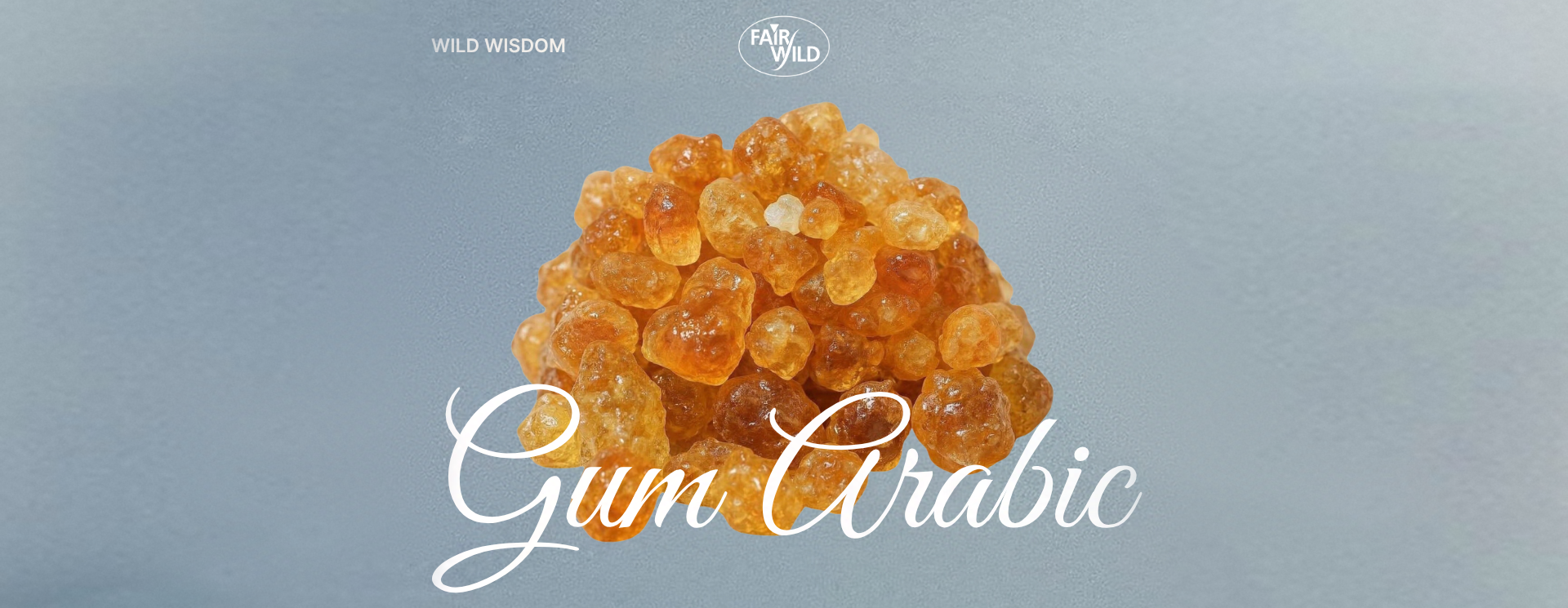
Few wild ingredients are as quietly essential to our lives as Gum Arabic.
Also known as acacia gum (food additive E414), it's a workhorse ingredient in the food, beverage, cosmetic, pharmaceutical and manufacturing industries, prized as a natural emulsifier, stabiliser, thickener and binder. It's in your soft drinks, your gummy sweets, your printing inks and countless personal care products, almost always without a second thought from the consumer holding the bottle.
A booming trade, an invisible supply chain
Gum Arabic is a natural, dried sap harvested mainly from the Senegalia senegal tree (formerly Acacia senegal), and also from Vachellia seyal, across the dry "Gum Belt" of sub-Saharan Africa. Global exports now top 100,000 tonnes a year, and have nearly tripled since the early 1990s.
The trade has real potential for good. It provides a crucial economic safety net across the Gum Belt, including in Sudan, Chad and Nigeria. Collected by hand during the December to June dry season, Gum Arabic offers vital income for smallholders, women and seasonal ranchers when there is little other work, in some of the driest, most economically marginal landscapes on the continent.
The trees themselves are just as valuable. Senegalia senegal is uniquely adapted to arid environments, and planting it prevents soil erosion, retains groundwater and restores nutrients to degraded land. That makes it a key species in landscape restoration projects like Africa's Great Green Wall, aimed at halting desertification and recovering biodiversity.
But that same growth has exposed hard problems. Much of the trade runs through opaque, multi-layered supply chains, with limited traceability back to the harvesters themselves. Harvester pay is low, and some of the world's primary producing regions sit within active conflict zones. This raises serious, largely unaddressed questions about labour conditions, fair pricing and who actually benefits as global demand climbs.
Where FairWild fits in
FairWild has identified Gum Arabic as a priority ingredient: a wild-harvested product where the case for standard-based certification is urgent, but where the infrastructure to deliver it is still being built. FairWild-certified operators already working with Gum Arabic are demonstrating what's possible: sustainable harvesting practices, verified supply chains and fairer terms for collectors, applied to a resin traded in volumes of over 100,000 tonnes a year.
Happening today: join the conversation
This afternoon, FairWild is co-hosting an initial Multi-Stakeholder Roundtable on responsible Gum Arabic sourcing, alongside einhorn products GmbH and naturamus GmbH. The online session brings together brands, importers, processors, grower associations and human rights and environmental NGOs to confront the sustainability and transparency challenges facing the sector head-on, and to begin exploring a joint Declaration of Intent for the industry.
You'll hear directly from speakers including Deborah Vorhies (FairWild), Linda Preil (einhorn products), Thomas Klingensmith (Mountain Rose Herbs), Violaine Fauvarque (Alland & Robert), Guillaume Delaunay (Biosylx) and Dahir Kulmiya (Nagaad Resins & Gums), offering perspectives from across the full Gum Arabic supply chain, from harvesters and processors to the brands bringing it to market.
It's exactly the kind of conversation FairWild Week exists to spotlight: an ingredient everyone uses, a supply chain few understand, and a growing coalition determined to change that.
📅 Today, 8 October 2026 | 15:00-17:00 CEST
📍 Online
Register now: https://docs.google.com/forms/d/e/1FAIpQLScSUNwrctbBPmNpJiJj5lLvmyBBKuWKKFLe7bujxri4Ars3Cw/viewform