FairWild Impact Report 2025
2025 was a groundbreaking year for the FairWild Foundation. With the consolidation of the FairWild Standard 3.0, revision of the certification process, and the roll out of new services, growth was achieved at its highest rate for four years. One of the more notable milestones was 100 worldwide FairWild partners reached, which reflects not only the growing demand for ingredients sourced fairly and sustainably, but also the amount of collaboration that goes into the FairWild cause.
From the pioneering certification of Wadi Dawkah in the Arabian peninsula, to empowering hundreds of thousands of women across the African ‘Shea Belt’, it has been a year with many firsts for FairWild. Our expansion into the fragrance industry has opened up new avenues and partnerships, while the launch of our Microenterprise Audits has made certification accessible to small scale wild-harvest operations.
In addition, the Impact Report details case studies of our key highlights, and the global wild-harvesting projects that FairWild is involved with.
“2025 was the year the market spoke. Crossing the Threshold of 100 partners in the FairWild network was not just a number. It was a signal that responsible wild sourcing is moving from the margins to the mainstream.”

Highlights of 2025
ecological
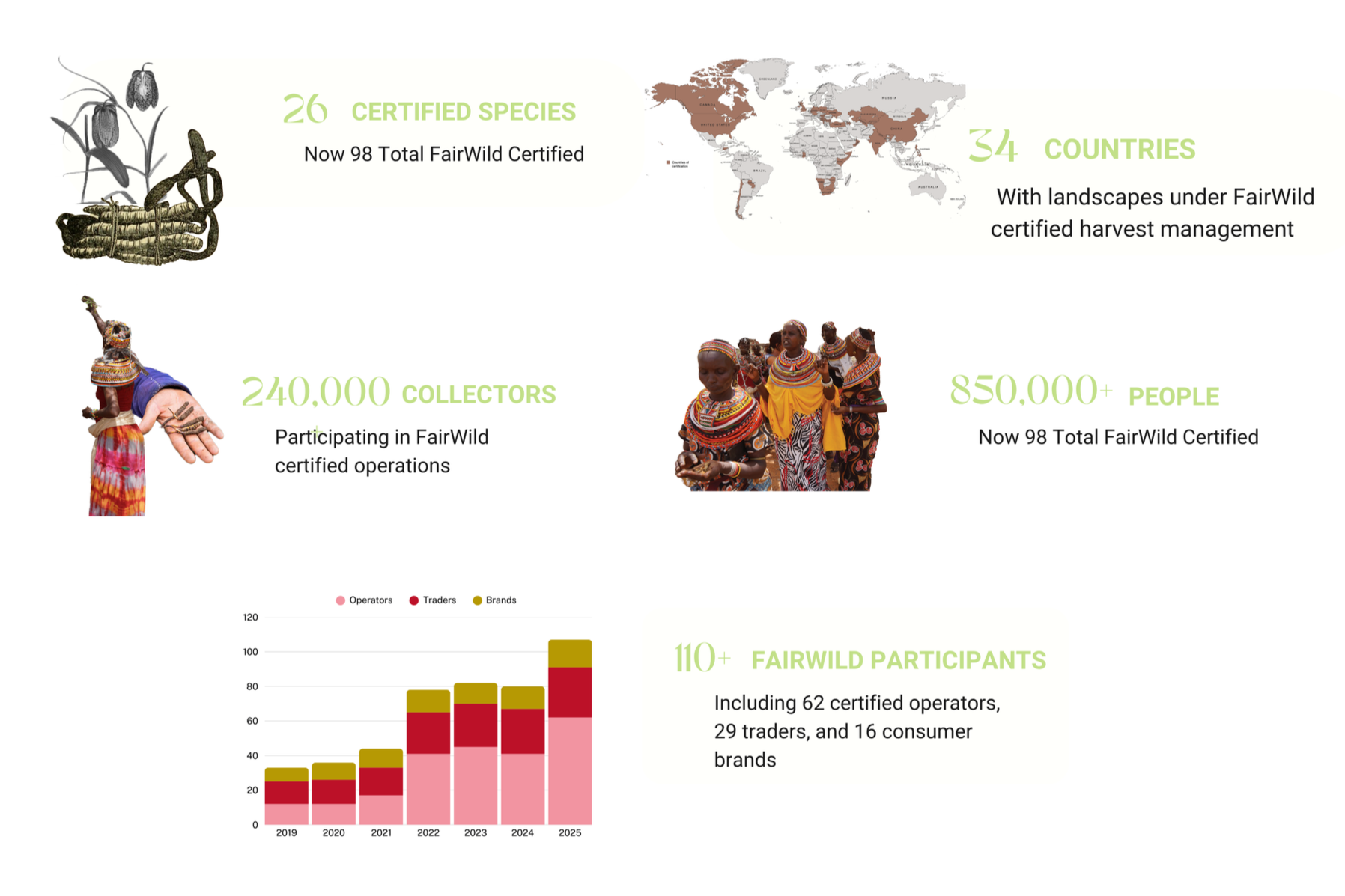
FairWild now has 98 certified species across 34 countries on 4 continents. This equates to 4.5 million hectares of wild ecosystems protected under FairWild-certified management and 60,000 tonnes of wild ingredients harvested without compromising regeneration.
Sustainable harvesting is not just minimizing damage in these areas, it is supporting the local ecosystems to thrive.
socio-cultural
There is now a total of 62 certified collection operations, and over 240,000 wild collectors are engaged in FairWild-certified collection, following best practices and receiving fair compensation.
More broadly, over 850,000 people are now benefitting from FairWild certification, including collectors, local workers and household members. This is a big jump from the 36,000 in 2024, which is partly due to improved reporting from partners like AAK and improved community reach.
Finally, 188,000 CHF in FairWild premium fund payments have been dispersed to local collector groups for reinvestment in health, safety, climate resilience and livelihood infrastructure.
Business
Alongside reaching 100+ new FairWild partners, 2 partnerships stood out as firsts for FairWild. 2025 saw the first ever FairWild certification for shea kernels, via AAK’s Kolo Nafaso Programme. The programme directly empowers 230,000 women collectors across Africa, and the partnership has since (2026) achieved product-level accreditation, allowing customers of AAK’s shea-based emollients can trust the origin and positive impact of the supply chain. Secondly, certification of the Amouage team at the Wadi Dawkah site in Oman is the first ingredient-sourcing site in the Arabian Peninsula to achieve this. It marked a significant step forward in the Frankincense industry, as well as signalling FairWild’s expansion into the fragrance industry.
In line with this expansion into fragrance, we had our first stand at In-Cosmetics Global in 2025. Opportunities like this were key to reaching new audiences and reinforcing demand for traceable, responsibly sourced wild ingredients.
Our growth in 2025 was also linked to the launch of a suite of new services. We introduced enhanced assurance assessments, streamlined audit pathways and micro-audits.
FairWild in numbers 2025
Looking Ahead to 2026
At the heart of FairWild, there has always been a conviction that every ingredient, landscape and community has a uniqueness. Each wild-harvesting supply chain has its own risks and contexts that require a nuanced and bespoke understanding.
FairWild’s direction in 2026 is based on this case-by-case specificity, which demands tools that are as contextualised as the landscapes themselves. As a result, human rights stand out as a key priority in 2026. The risks associated with wild harvested ingredients are distinct from those found elsewhere in natural ingredient supply chains. Addressing them requires a purpose built approach which we will roll out through the FairWild Human Right’s Tool.

“This is the thread that runs through everything we do: the belief that lasting change in wild places demands not just standards, but sustained, contextualised commitment. To the ingredient, to the landscape, to the people.”
For further enquiries, please contact us at business@fairwild.org.